Ursus
The Man Who LaughsUrsus is a wandering performer, doctor and self-styled philosopher whose declared hatred of humanity sits in persistent tension with the care he gives the sick, the poor and the children he takes into his household. His partnership with Homo and his guardianship of Gwynplaine and Dea make him more than a comic misanthrope: he is the practical center of a fragile family, and its eventual losses leave him alive to mourn those who made that family meaningful.
Identity and the travelling life
Ursus makes a living at fairs, village gatherings and crowded street corners with Homo, a wolf whose temperament he considers suited to his own. He has named the animal Homo and, the narrative suggests, chosen Ursus for himself. Their act draws an audience with the familiar pleasures of spectacle, conversation and the appearance of a tamed animal. Homo is gentle and deferential; the contrast with Ursus is pointed, since the wolf never bites, while Ursus sometimes intends to. Their work is not simply entertainment: it is how the pair meet the material demands of living.
Ursus's performances depend on a varied collection of skills. A juggler, he is also a ventriloquist capable of imitating accents and voices so closely that listeners may think the people themselves are speaking. He can simulate the murmur of a crowd alone, a talent for which he takes the name Engastrimythos, and reproduces the calls of birds. In introducing the travelling company, he presents Homo as one of four associated artists and turns the wolf's supposed lack of aristocratic prejudice into part of the entertainment. The performance makes their difference into a shared livelihood: Homo is not merely an animal kept in the background but a partner whom Ursus gives a public character and a place in the act.
Their home is a long, wide van, at once shelter and working space. Its modest furnishings include a lantern, wigs, utensils hanging from nails and musical instruments; Ursus keeps a bearskin for grand performances and calls it his full dress. He jokes that he has two skins, pointing to the bearskin as the real one. Charcoal words written on the inside of the van's ceiling can be read through a small rear window by people passing outside. The makeshift dwelling thus serves as both private refuge and a surface on which the travelling philosopher presents himself to the world.
Misanthropy and practical mercy
Ursus's misanthropy is not a passing pose. He regards human life as a succession of compounded miseries, with political power, war, disease, famine and folly layered upon existence itself; from that bleak reasoning he concludes that death can be a deliverance. Yet the actions that follow contradict any simple reading of him as indifferent to suffering. When a sick person is brought to him, he treats the illness. He keeps remedies to prolong the lives of the old, helps people with impaired mobility, and gives his available pennies to a poor person dying of hunger.
His care is expressed through the same abrasive voice with which he defends his contempt for humankind. He accompanies treatment and almsgiving with sarcasm, as though an insult could keep kindness from looking sentimental or invite the recipient to mistake it for admiration. The inconsistency is central to his character: he can judge life a punishment and still refuse to make another person's burden worse. His practical mercy is not a conversion from pessimism into optimism; it is an ethic enacted despite pessimism. He does not need to believe that the world is good in order to feed, treat or shelter someone within it.
The van becomes a household
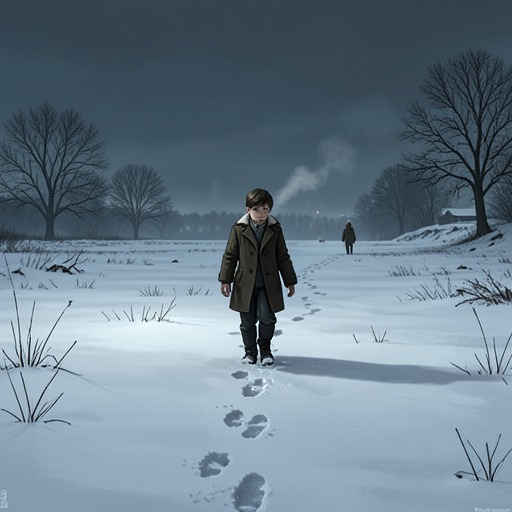
That ethic becomes most consequential when a child arrives at the van carrying an infant. Ursus first directs the cold, ragged child toward the fire, then discovers the baby inside the jacket. He repairs the broken window with a rag, feeds peat into the stove, spreads the bearskin over a chest and props it with a large book so the sleeping infant has a pillow. These small acts turn the van's performance equipment and scant furnishings into immediate shelter.
Ursus accepts the infant into the household, imagining himself as the child's father and Homo as its uncle. His decision is at once comic in its domestic language and decisive in its consequence: the itinerant pair become guardians. The children are not treated as interruptions to the act but as members of a household sustained by its members' work. Ursus's later bond with Dea carries the same fatherly care, while Gwynplaine becomes his ward, pupil and comrade. He teaches and upbraids Gwynplaine, but the severity of his voice does not cancel the attachment beneath it. The van that once offered a stage for strangers becomes the setting for lasting bonds.
Ursus also makes family life out of performance. When Gwynplaine disappears, he tells the others that there will be no show that night or for the following days, because Gwynplaine is gone. Later, believing that Dea must be protected from the shock of the situation, he maintains the appearance that matters have not become irreparable. He tells Homo that he has tried to gain time and hopes Gwynplaine may return the next day. This is not merely a decision to keep the troupe working; it is an effort to preserve Dea's hope while Ursus himself is in danger of despair. His skills as an actor and ventriloquist stand in contrast to this private performance: here he uses concealment not to fool an audience for profit, but to postpone pain for someone he loves.
Loyalty under threat and loss
When Gwynplaine is taken into Southwark Prison, Ursus watches him disappear behind the gates and remains fixed in the corner from which he has been observing. The sound of the bolts and bars stays with him. The scene gives his attachment a new measure: the man who habitually treats humanity with contempt cannot dismiss the machinery of confinement as an abstraction when it closes around his own companion.
Under pressure to leave, Ursus offers to go with the others aboard The Vograat, and to sell the Green Box, the horses and the troupe's other possessions. But he insists that Gwynplaine cannot be left behind. The offer exposes the order of his loyalties: the van, the act and the means of earning a living can all be surrendered; the companion he regards as family cannot be set aside without protest. His resolve cannot undo the separation, and the household's continued movement becomes a departure marked by absence rather than a return to its former life.
Aboard ship, Ursus attends to Dea as she grows dangerously weak. He keeps watch over her rest, tries to limit the disturbance around her and asks those nearby to be quiet. He explains the vessel to her gently when she does not understand why the house is moving, and urges her not to agitate herself. The old performer who once entertained crowds now uses his voice in a small, intimate way: to reassure a frightened daughter and protect her from further strain. His medical knowledge gives him practical tasks, but it cannot grant him control over her illness.
When Gwynplaine returns, Ursus is overwhelmed by the sight of the two together. He privately acknowledges his love for them both and takes joy in their reunion as a spectator nourished by their happiness. That happiness is brief. When Dea dies, Ursus says that she is dead and collapses in grief, his face buried in the folds of her gown. After he regains consciousness, Gwynplaine is gone; Homo stands at the edge of the deck looking down at the water. Ursus's story ends not with a resolution of his misanthropy but with its deepest personal test: he survives the deaths and disappearances that hollow out the family he had built.
Narrative role and significance
Ursus's importance lies in the gap between his declared view of humanity and his repeated conduct toward particular human beings. His insults and gloomy philosophy establish a hard exterior; his remedies, pennies, fire, bearskin and careful attention to Dea show what that exterior cannot erase. Compassion in his life is practical and material, not a claim that suffering has been overcome. It consists of keeping someone warm, tending the sick, taking responsibility and refusing to abandon a companion.
His relationship with Homo extends that household beyond the human pair. The wolf is a working partner and intimate witness, not simply a prop in Ursus's act, and Ursus's affectionate language gives their companionship the terms of kinship. Together they form the durable base around which the abandoned children find care. As the family is repeatedly broken apart, Ursus becomes its survivor and its witness. His final grief recasts the rough comic performer as the book's register of attachment: a man who speaks as though life were a sentence, yet spends his life trying to ease it for others.